

0 days
Average waiting time until intake

Egg freezing (oocyte vitrification) is a fertility treatment in which mature eggs are collected and frozen. The eggs can be thawed at a later stage and used during fertility treatment.
Egg freezing, also known as oocyte vitrification or social freezing, is a way of preserving eggs at a younger age for later use. Hormone treatment stimulates several eggs to mature, which are then retrieved and rapidly frozen. This may be necessary for medical reasons, or it may be a conscious choice to postpone your wish to have a child. By freezing your eggs in good time, you increase your chances of a successful pregnancy in the future and stay in control of your own fertility.
For women who want to postpone having children, for example:
By having your eggs frozen, you keep your options open, whatever your situation.
If you have an increased risk of early menopause (premature ovarian insufficiency), for example because it runs in your family, freezing your eggs for future use may be a good solution for you.
If you have a medical reason, such as cancer treatment or gender transition, you may want to have your eggs frozen beforehand.

Over 2 to 3 consultations, we will discuss the following topics to assess whether egg freezing is suitable for you:

In a natural cycle, normally 1 or 2 eggs mature. During the stimulation phase, the ovaries are stimulated daily with hormones so that several follicles grow. This phase lasts 10 to 14 days and is followed by trigger medication (an hCG injection) to trigger ovulation. Follicle growth is monitored by ultrasound.
Stimulation protocols
There are several stimulation protocols, which the doctor will discuss with you. Once it is clear which protocol is right for you, the nurse will explain it to you in more detail.
Stimulation phase
During the stimulation phase, you will have several monitoring appointments. At each appointment, we assess your ovaries with a (transvaginal) ultrasound scan, looking at the number and size of the follicles.
It is not possible to say in advance how many monitoring appointments you will need (on average 2 to 4). Once the follicles are large enough, we will schedule the egg retrieval.
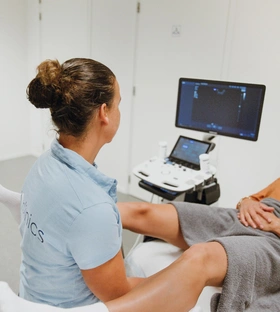
During the egg retrieval, the eggs are removed from the ovaries. This is done at our clinic (Elsendorp & Wolvega) by a doctor, assisted by a nurse.
Egg retrieval in detail
On the day of the egg retrieval, you report to the receptionist and take a seat in the waiting room. Before the procedure, you will be given a sedative or painkiller through an IV drip. The follicles are punctured through the vagina using a transvaginal ultrasound probe and a needle guide. The fluid in the follicles is drawn out through this needle. The eggs are in the collected follicular fluid, but cannot be seen with the naked eye. The procedure takes about 15 minutes.
After the egg retrieval
Immediately after the retrieval, the tubes of follicular fluid are handed to the IVF lab technician, who looks for the eggs under the microscope in the laboratory. After the retrieval, you stay in the recovery room for a short period of observation. The doctor will tell you how many eggs have been found and give you written instructions for the period ahead.
Visiting our clinics
The intake and stimulation take place at a location of your choice. For the egg retrieval and freezing, you travel once to Elsendorp or Wolvega. Together, we will look at which location suits you best, based on your situation, preference and any waiting times.
More information about what happens during an egg retrieval.
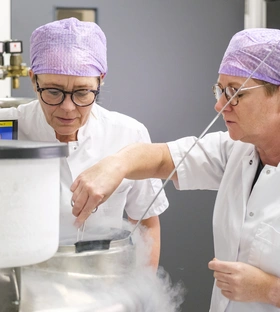
Only mature eggs are suitable for freezing. After the egg retrieval, the eggs are stripped of their layer of surrounding cells (cumulus cells) so that their maturity can be assessed. The final result, how many eggs are suitable for freezing, is known later that day. The number of eggs retrieved is therefore often higher than the number that can actually be frozen.
-196°C
The freezing method is called oocyte vitrification. This method prevents, as far as possible, the formation of ice crystals that could damage the eggs. The frozen eggs are stored in a tank of liquid nitrogen (-196°C). The eggs can be stored at this temperature for many years.
Feedback
On the day of the egg retrieval, you will hear how many mature eggs have been frozen. We will let you know how we will share this with you. The day after the retrieval, we will contact you to ask how your recovery is going and whether you would like a follow-up consultation with a doctor, and when. During this follow-up consultation, a doctor will discuss the course and outcome of the first treatment with you. The doctor will also discuss whether we recommend a second treatment to increase your chances of a pregnancy later on.
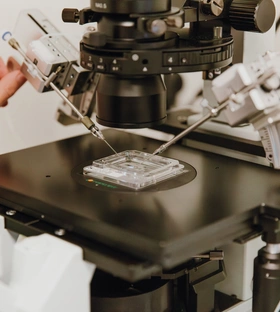
If your wish to have a child later on is not fulfilled naturally, you can contact Nij Clinics. If, after the intake, it turns out that using your frozen eggs is the best option, we will start ICSI fertility treatment. This is the only way to fertilise eggs after thawing (with sperm from your partner or a donor) and allow them to develop into an embryo that can be transferred. A well-developed embryo is transferred to your womb, after which a pregnancy can develop.
Chances (indicative averages):
Chance of a baby: 5% per frozen egg
The success rates of egg freezing depend heavily on the woman's age. A woman's natural fertility already starts to decline in her late twenties, because she has fewer eggs and because the quality of the remaining eggs decreases as she gets older.
The chance of success with egg freezing therefore depends largely on the woman's age and the number of eggs retrieved. Currently, the chance of a live birth is on average 5% per thawed egg². This chance varies from person to person.
¹For egg freezing on medical and ethical grounds, we do not apply a strict minimum age.
²These statistics are averages. No rights can be derived from them.
⁴incl. discount of €198.59
³No rights can be derived from this sample calculation; the current fees can be found on our list of fees.
⁴incl. discount of €198.59
⁴No rights can be derived from this sample calculation; the current fees can be found on our list of fees.
³No rights can be derived from this sample calculation; the current fees can be found on our list of fees.
The costs of egg freezing consist of appointments with specialists, the treatment, the medication and the annual storage costs.
For an indication of the costs, please see our list of fees.
Egg freezing without a medical indication is not covered by health insurers. You therefore pay for the consultations, the treatment including medication and the egg storage costs yourself.
Please bear in mind possible additional costs (uninsured care):
The costs of the counselling session and the storage costs are listed on our list of fees.
Use this form to register easily for an egg freezing intake appointment.
Egg vitrification is highly age-sensitive. Women are born with a large supply of eggs. Over the years, this supply declines in both number and quality. Particularly from the age of 35, quality and number decline more rapidly, which reduces the chance of a successful pregnancy.
Optimal age
By freezing your eggs at a younger age, preferably between 30 and 35, you increase your chance of a successful pregnancy later on. At that point the eggs are still of high quality and, once frozen, they remain in that optimal state.
Egg freezing treatment takes about two weeks on average from the start of your menstrual cycle. Shortly after your period starts, you begin hormonal stimulation with daily injections, which you give yourself for about 8 to 11 days. These hormones stimulate the ovaries to mature several follicles, instead of the single follicle that normally matures each cycle. During this phase you will have several ultrasound scans to check how the follicles are developing.
Egg retrieval
When enough follicles have reached the right size, an egg retrieval is scheduled. This procedure, in which the eggs are removed from the follicles, takes about 15 minutes. After the retrieval, the laboratory assesses the eggs and freezes them using a specialised technique. Immediately after the retrieval, you will hear how many eggs were collected and whether a second treatment is recommended to increase your chances of a pregnancy later on.
If a later wish to have a child is not fulfilled naturally, you can contact Nij Clinics. If the intake shows that using your frozen eggs is the best option, ICSI fertility treatment will be started. This is the only way to fertilise eggs after thawing (with sperm from your partner or a donor) and allow them to develop into an embryo that can be transferred. A well-developed embryo is transferred to your uterus, after which a pregnancy can occur.
ICSI
More information about ICSI treatment.
If you have had your eggs frozen, you may end up not using them. This may be because you later became pregnant naturally with the eggs you had at that time, or because you no longer wish to have a child.
Sometimes it is sensible to keep the eggs frozen for a possible second or third child, in case this unexpectedly does not happen naturally.
Are you completely sure that you no longer want to (or are no longer allowed to) use your frozen eggs? Then you can consider these options:
Together with your doctor, you will discuss which option suits you best.
